










Item out of stock
Selling fast! Item low in stock
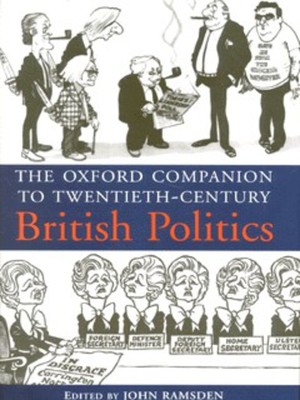
The Oxford companion to twentieth-century British politics - John Ramsden
Oops!
Unfortunately it looks like someone took the last one.
Unfortunately it looks like someone took the last one.
No worries, we have many more interesting finds for you.
Browse similar
Why choose musicMagpie?
Title
The Oxford companion to twentieth-century British politics
The Oxford companion to twentieth-century British politics
Author
John Ramsden
John Ramsden
format
Hardback
Hardback
Publisher
Oxford University Press
Oxford University Press
Language
English
English
UK Publication Date
20020228
20020228
Description
The beginning of the 20th century wasn't a significant time in itself for change in British politics, except perhaps for the founding of the Labour Party, but a gradual shift in the political landscape had been taking place. This was a time when the status of the United Kingdom as a great imperial power and as a strong industrial economy was just about coming to an end.;The end of the 20th century gave quite a different picture. It showed a country struggling with the issue of integration into Europe (a concept barely imagined 100 years previously), a more service- less industry-orientated economy, and a political system less focused on Westminster and more focused on the regions than ever before.;The challenge facing those involved in compiling The Companion to 20th-Century British Politics was to incorporate the wide breadth of subject matter covering the events, themes, ideas, people, institutions, and places that have been important in shaping the path of political history of Britain over the past 100 years. The result is the most comprehensive and authoritative source of reference on 20th-century British politics ever written.;Exploring a diverse range of topics over 100 specialist contributors, under the guidance of a team of distinguished advisory editors, have written more than 3,000 entries.;All the major political organisations that have functioned during the 20th century are mentioned. There are also biographical entries including longer entries on all prime ministers and holders of key cabinet posts and shorter entries on many junior ministers, influential backbenchers, and party organisers. The book also covers key areas of economic, social, legal, foreign, and defence policies with special attention devoted to the politics of Wales, Scotland, and Ireland. Historical events and their impact on the shape of political thinking are described in detail. Political concepts and ideas also have entries devoted to them, as do social and economic issues. Topics of international debate such as those concerned with Europe, NATO, and Anglo-American relations are discussed at length.;The whole period is covered, from the foundation of the Labour Party to mad cow disease and even the result of the 2001 general election.;BIOGRAPHIES: PMs and leaders of the major and lesser parties: Harold Wilson, Tony Blair, David Steel, Oswald Mosley, William Hague, Margaret Thatcher; politicians: Ernest Bevin, Violet Bonham Carter, Martin Bell; royalty: Diana, Princess of Wales, George V, George VI; private secretaries to royalty: Robert Fellowes, Francis Knollys; diplomats: Lord Caradon, Oliver Harvey ; judges: Cyril Radcliffe, Lord Trevethin; spies: John Cairncross, Oleg Gordievsky; modern influential figures: Mo Mowlam, Ken Livingstone, Gerry Adams; civil servants: William Beveridge, Burke Trend; key thinkers and writers: Friedrich von Hayek, J. M. Keynes, A. J. P. Taylor, Harold Laski, Max Weber; figures in the media: Robin Day, Robert Maxwell; industrialists: Charles Clore, Alfred Mond, Evan Williams; trade unionists: Frank Cousins, Arthur Scargill, George Woodcock;EVENTS: major conflicts and wars: Falklands war, Gulf war, Second World War; crises: oil crisis, Beef war; economic events: Black Wednesday, convertibility crisis; political events: Black Monday, referendum pledge, Tonypandy, Westland affair, Zinoviev letter; Ireland: Drumcree, Easter Rising, Peace Process mark I, Peace Process mark II; Europe: Bruges speech, Lome convention; International events: Blitz, Norway debate, Wall Street crash
Why buy with musicMagpie?

FREE 12 Month Warranty on Tech

Magpie Certified Refurbished Tech

FREE Delivery on ALL Orders

14 Day Money Back Guarantee

90 Point Refurbished Quality Check
If you’re looking for something new to listen to, watch or play, look no further than the musicMagpie Store. We sell over half a million new and used CDs, DVDs, Blu-Rays, Games and Vinyl, spanning all kinds of genres and consoles, with prices starting from just £1.09! We also sell a wide range of refurbished Mobile Phones and Tech from major brands like Apple, Samsung, Sony, Microsoft and much more. With a 12 month quality warranty, you can save with total confidence.