










Item out of stock
Selling fast! Item low in stock
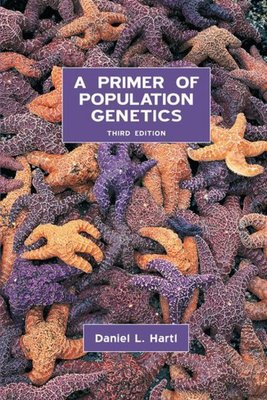
A primer of population genetics - Daniel L Hartl
Oops!
Unfortunately it looks like someone took the last one.
Unfortunately it looks like someone took the last one.
No worries, we have many more interesting finds for you.
Browse similar
Why choose musicMagpie?
Title
A primer of population genetics
A primer of population genetics
Author
Daniel L Hartl
Daniel L Hartl
format
Paperback / softback
Paperback / softback
Publisher
Oxford University Press
Oxford University Press
Language
English
English
UK Publication Date
19991006
19991006
Description
Published by Sinauer Associates, an imprint of Oxford University Press.
In response to many requests, A Primer of Population Genetics, Third Edition, has been dramatically shortened and streamlined for greater accessibility. Designed primarily for undergraduates, it will also serve for graduate students and professionals in biology and other sciences who desire a concise but comprehensive overview of the field with a primary focus on the integration of experimental results with theory. The abundance of experimental data generated by the use of molecularmethods to study genetic polymorphisms sparked a transformation in the field of population genetics. Present in virtually all organisms, molecular polymorphisms allow populations to be studied without regard to species or habitat, and without the need for controlled crosses, mutant genes, or for any priorgenetic studies. Thus a familiarity with population genetics has become essential for any biologist whose work is at the population level. These fields include evolution, ecology, systematics, plant breeding, animal breeding, conservation and wildlife management, human genetics, and anthropology. Population genetics seeks to understand the causes of genetic differences within and among species, and molecular biology provides a rich repertoire of techniques for identifying these differences.The book is organized as a user's guide to population genetics. Chapter 1 starts with the basic concepts of molecular genetics and examines the principal methods by which DNA (or proteins) can be manipulated to reveal genetic polymorphisms in any population. Chapter 1 also includes the principles of population genetics underlying the organization of genetic variation in populations, with special emphasis on random mating, linkage equilibrium and disequilibrium, and inbreeding.Chapter 2 examines the evolutionary processes that can change allele frequencies, including mutation, migration and population admixture, natural selection of various types, and random genetic drift. This chapter also includes an elementary explanation of the diffusion equations as used in population genetics.Chapter 3 is the core of molecular population genetics. It includes the analysis of nucleotide polymorphism and diversity based on coalescents, patterns of change in nucleotide and amino acid sequences with special emphasis on codon usage bias and amino acid polymorphisms, inferences based on comparisons of levels of polymorphism and divergence, molecular phylogenetics, and the population dynamics of transposable elements.Chapter 4 focuses on complex traits whose expression is influenced by multiple genes and environmental factors. It examines genetic effects on the components of phenotypic variation and the correlations between relatives, the evolution of quantitative traits in natural populations, and comes full circle with the use of molecular polymorphisms and candidate genes in the identification of quantitative trait loci underlying complex inheritance.As for mathematical rigor, while there are some equations, the emphasis is on explanation rather than derivation. Only elementary algebra is necessary to follow most of the material, but a familiarity with basic calculus is helpful for understanding diffusion equations, Poisson random fields, and complex threshold traits. Mathematical symbols are used consistently throughout the book, and when results from the theoretical literature are quoted, the original symbols have been changed asnecessary to maintain consistency.Modern population genetics makes liberal use of acronyms-these are all defined in the text, and their interrelations and implications are discussed. For ease of reference there is a glossary of acronyms and other common abbreviations used in population genetics. The text also includes numerous practical examples showing how the theoretical concepts are applied to actual data, as well as chapter-end problems.
In response to many requests, A Primer of Population Genetics, Third Edition, has been dramatically shortened and streamlined for greater accessibility. Designed primarily for undergraduates, it will also serve for graduate students and professionals in biology and other sciences who desire a concise but comprehensive overview of the field with a primary focus on the integration of experimental results with theory. The abundance of experimental data generated by the use of molecularmethods to study genetic polymorphisms sparked a transformation in the field of population genetics. Present in virtually all organisms, molecular polymorphisms allow populations to be studied without regard to species or habitat, and without the need for controlled crosses, mutant genes, or for any priorgenetic studies. Thus a familiarity with population genetics has become essential for any biologist whose work is at the population level. These fields include evolution, ecology, systematics, plant breeding, animal breeding, conservation and wildlife management, human genetics, and anthropology. Population genetics seeks to understand the causes of genetic differences within and among species, and molecular biology provides a rich repertoire of techniques for identifying these differences.The book is organized as a user's guide to population genetics. Chapter 1 starts with the basic concepts of molecular genetics and examines the principal methods by which DNA (or proteins) can be manipulated to reveal genetic polymorphisms in any population. Chapter 1 also includes the principles of population genetics underlying the organization of genetic variation in populations, with special emphasis on random mating, linkage equilibrium and disequilibrium, and inbreeding.Chapter 2 examines the evolutionary processes that can change allele frequencies, including mutation, migration and population admixture, natural selection of various types, and random genetic drift. This chapter also includes an elementary explanation of the diffusion equations as used in population genetics.Chapter 3 is the core of molecular population genetics. It includes the analysis of nucleotide polymorphism and diversity based on coalescents, patterns of change in nucleotide and amino acid sequences with special emphasis on codon usage bias and amino acid polymorphisms, inferences based on comparisons of levels of polymorphism and divergence, molecular phylogenetics, and the population dynamics of transposable elements.Chapter 4 focuses on complex traits whose expression is influenced by multiple genes and environmental factors. It examines genetic effects on the components of phenotypic variation and the correlations between relatives, the evolution of quantitative traits in natural populations, and comes full circle with the use of molecular polymorphisms and candidate genes in the identification of quantitative trait loci underlying complex inheritance.As for mathematical rigor, while there are some equations, the emphasis is on explanation rather than derivation. Only elementary algebra is necessary to follow most of the material, but a familiarity with basic calculus is helpful for understanding diffusion equations, Poisson random fields, and complex threshold traits. Mathematical symbols are used consistently throughout the book, and when results from the theoretical literature are quoted, the original symbols have been changed asnecessary to maintain consistency.Modern population genetics makes liberal use of acronyms-these are all defined in the text, and their interrelations and implications are discussed. For ease of reference there is a glossary of acronyms and other common abbreviations used in population genetics. The text also includes numerous practical examples showing how the theoretical concepts are applied to actual data, as well as chapter-end problems.
Why buy with musicMagpie?

FREE 12 Month Warranty on Tech

Magpie Certified Refurbished Tech

FREE Delivery on ALL Orders

14 Day Money Back Guarantee

90 Point Refurbished Quality Check
If you’re looking for something new to listen to, watch or play, look no further than the musicMagpie Store. We sell over half a million new and used CDs, DVDs, Blu-Rays, Games and Vinyl, spanning all kinds of genres and consoles, with prices starting from just £1.09! We also sell a wide range of refurbished Mobile Phones and Tech from major brands like Apple, Samsung, Sony, Microsoft and much more. With a 12 month quality warranty, you can save with total confidence.