










Item out of stock
Selling fast! Item low in stock
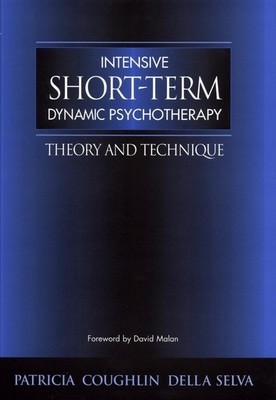
Intensive short-term dynamic psychotherapy - Patricia Coughlin Della Selva
Oops!
Unfortunately it looks like someone took the last one.
Unfortunately it looks like someone took the last one.
No worries, we have many more interesting finds for you.
Browse similar
Why choose musicMagpie?
Title
Intensive short-term dynamic psychotherapy - theory and technique
Intensive short-term dynamic psychotherapy - theory and technique
Author
Patricia Coughlin Della Selva
Patricia Coughlin Della Selva
format
Hardback
Hardback
Publisher
John Wiley & Sons, Inc.
John Wiley & Sons, Inc.
Language
English
English
UK Publication Date
19960429
19960429
Description
Traditional psychoanalytic thinking dictates that the only way to help most patients achieve significant insight resulting in lasting change is through a rigorous course of lengthy treatment involving anywhere from two to five sessions a week. Needless to say, the prospect of such a monumental therapeutic undertaking is repugnant to health insurers and clearly beyond the means of the majority of patients. As a consequence, the past two decades have witnessed a rise in popularity of several short–term psychotherapeutic approaches. Most well known among these is the intensive short–term dynamic approach first developed by Habib Davanloo in the late 1960s. A proven technique for accelerating and condensing the analytic process while remaining true to basic psychoanalytic principles, Davanloo's method has met with nothing less than miraculous results in case after reported case. Yet, until now, there has not been a clearly written, accessible guide devoted to schooling practitioners in the theory and practice of this revolutionary psychotherapeutic method.
Patricia Coughlin Della Selva's Intensive Short–Term Dynamic Psychotherapy shows therapists how to achieve even the most ambitious therapeutic goals, including character change, in as few as 40 sessions. Not a cookbook, but a systematic guide to intervention, it outlines proven techniques for accessing a patient's ego–functioning, dismantling defenses, intensifying a patient's affective involvement in the treatment, identifying the transference patterns as they arise, and "unlocking the unconscious" with a speed and degree of accuracy previously considered impossible.
The book opens with a chapter in which the author lays down the theoretical foundations of the method. She supplies a detailed review of the psychoanalytic theory of neurosis, provides operational definitions of dynamic concepts, and defines strategies for observing unconscious processes. The remainder of the book is devoted to clinical practice. Following a format roughly paralleling the psychotherapeutic process, it details the requirements of initial evaluation; describes techniques for working with defenses; explains the role of affect in creating and remediating psychopathology; describes techniques for intensifying affective experience and facilitating its expression; details methods of enhancing and completing the working–through process; and outlines procedures for the successful termination of and follow–up to the course of treatment.
A book whose time has come, Intensive Short–Term Dynamic Psychotherapy makes accessible to the psychotherapeutic community at large a treatment model that has been described as "the most important development in psychotherapy since the discovery of the unconscious."
Of related interest . . .
UNLOCKING THE UNCONSCIOUS
selected papers of Habib Davanloo
These selected papers represent a valuable account of the development over several years of a powerful and innovative technique for overcoming resistance and confronting problems of the unconscious. Davanloo's Intensive Short–Term Dynamic Psychotherapy offers a body of theoretical, metapsychological, and technical knowledge which can be used with extraordinary precision to mobilize unconscious mental processes in order to achieve therapeutic results. The clinical material presented demonstrates how a single interview can provide an opportunity for both the therapist and the patient to view the multifoci core of the patient's neurotic structure, which is responsible for the patient's symptoms and character disturbances. 1995 (0–471–95611–2) 344 pp.
UNBEARABLE AFFECT
a guide to the psychotherapy of psychosis
David A. S. Garfield
Unbearable affect is seen as the focal point around which psychosis turns. When emotion becomes unbearable, some psychotic patients suffer from delusions, hallucinations, incoherence, negativism, autism, or emotional paralysis. In this remarkable book, Dr. David Garfield establishes paradigms for the diagnosis and psychotherapeutic treatment of psychotic disorders based on the location, understanding, and reordering of unbearable affect. He provides concrete clinical advice, vivid examples, and crisp, jargon–free descriptions of theoretical concepts and clinical techniques. 1995 (0–471–02536–4) 177 pp.
Why buy with musicMagpie?

FREE 12 Month Warranty on Tech

Magpie Certified Refurbished Tech

FREE Delivery on ALL Orders

14 Day Money Back Guarantee

90 Point Refurbished Quality Check
If you’re looking for something new to listen to, watch or play, look no further than the musicMagpie Store. We sell over half a million new and used CDs, DVDs, Blu-Rays, Games and Vinyl, spanning all kinds of genres and consoles, with prices starting from just £1.09! We also sell a wide range of refurbished Mobile Phones and Tech from major brands like Apple, Samsung, Sony, Microsoft and much more. With a 12 month quality warranty, you can save with total confidence.