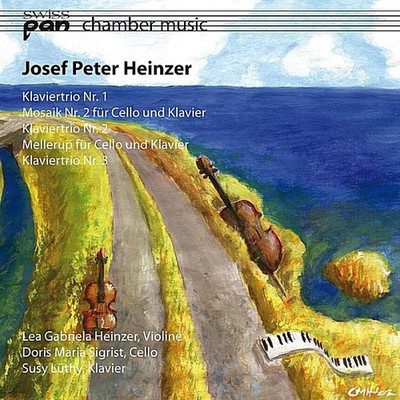
Description
Piano Trio No. 1 (1986) In summer 1986 I spent with my family two weeks in Agua de Pau (on São Miguel, one of the Azores islands). Near by was a wonderful rocky coast, but swimming and diving there was not advisable: too many jellyfish (Medusas). Usually we drove to the other side of the island where there were only few of them. I tried to capture and translate into music what had impressed me most. Every night we heard weird screams from animals, probably bats (Morcegos). We saw bubbling geysers even near villages producing suffocating vapors smelling like rotten eggs. We found sources of gushing hot water emerging from the bottom of the sea. No wonder we felt like living on a powder barrel (Caldeiras). Salemas (small fish, originally composed for the mosaic No 2) was added to the nine very short movements together with the additional short movement Peixes (fish). The first performance with the Winterthurer Klaviertrio (Nikolaos Ormanlidis, violin; Doris Maria Sigrist, cello and Susy Lüthy, piano), Feb. 25 1989, (Stadthaus, Musikkollegium Winterthur) was very successful, as were other performances. Mosaic No. 2 for Cello and Piano (1985) This is an early composition consisting of ten very short movements inspired from drawings I made in Teneriffa (therefore the Spanish titles). I. Oleaje (ocean waves). II. Conejo de mar (sea rabbit) actually a very big snail (about 30 cm long) without a shell. III. Sargos (breams). IV. Lenguado (flounder). V. Raya (ray). VI. Anquilas Jardineras (a kind of garden eels), they dig themselves into the sand of the sea bottom which looks like if a gardener had planted files of sticks with the upper end bent and looking all in one direction, coming closer to the sticks (eels) they became shorter and shorter and finally disappeared in the sand. VII. Salemas (small fish); VIII. Erizo Marino (sea urchin). IX. Gambas (crabs) my daughter, Lea, wanted that I "compose" her crabs. X. Tiburón (shark), one evening I wanted to refresh myself a bit and was swimming in deep water not far from the sea shore. Suddenly I observed a school of fish swimming very fast in one direction. Looking at the opposite direction where they came from I just saw two or three big fish turn and disappear in the deep blue. Discreetly I swam back to the shore. The fish could have been ground sharks (Tiburóns). First performance with Doris Maria Sigrist, cello and Regula Etter, piano, Oct. 31 1991, Seminar Kreuzlingen. Piano Trio No. 2 (1988/89) In Guadeloupe (French Caribbean) I also made drawings arranged in a 3 x 3 Mosaic (9 movements). I. The cicadas (Les Cigales) could not be over heard. As soon as it got dark they started chirping vigorously. II. Children playing (Les enfants jouants). III. Boxfish (Poisson coffre). V. Duo for cello and piano. VI. Piano solo (Les Coraux). VII. Emperor fish (poisson empereur). VIII. The squids (Les Calmars). IX. Pigeon island (Ile de pigeon) is a small romantic island in a nature reservation region founded by Jaques Yves Cousteau. X. La Soufrière is a volcano near Basse Terre not active. But there too, fumes evaporating from cavities, smelling like rotten eggs led to a somewhat uncertain feeling. As in the first piano trio there is also a piano solo and a duo but this time for cello and piano. When the Winterthurer Klaviertrio had the first rehearsal with the new trio, Nikolaos asked: "Where is my solo?" IV. Hummingbird (Colibri) was the answer (not easy to play). Therefore 10 movements. First performance: Third Ittinger Musiktage, June 30 1990, Winterthurer Klaviertrio (with Nikolaos Ormanlidis, Doris Maria Sigrist, Susy Lüthy). Mellerup • Duo for Cello and piano (1998) Mellerup is a small village near Randers (Denmark) bordering on the Randers Fiord. The five movements got the titles Mellerup I, II, III, IV, Fur I, and Fur II. Fur is a small island in the north of Denmark. At some places along the seashore of Fur one might be able to find petrified leaves. There are other places at steep parts of the coast where one can look at differently colored layers (Fur II) built from eruptions of former volcanos. A small ferry connects Mellerup with the other side of the Randers Fiord (Mellerup IV). First performance: Bern, Feb. 12 1998 at the "Pflegestätte für musische Kunst" (with Doris Maria Sigrist and Theresa Nerina Bracher). Piano Trio No. 3 (1994) Being able to take pictures and shoot underwater videos I stopped drawing. The inspirations helping to compose the eight movements stem in most cases from pictures, too. We spent two weeks in La Désirade, a small island near Guadeloupe. One day during a longer diving trip we met a shark (Le requin) underneath an open cave obviously sleeping (at least I was told that afterwards!). In order to film the entire shark I had to swim back and forth. I could see him breath and a pilot fish was swimming above his back. Recently, I looked at the film once again: what a good-natured shark allowing six divers to observe him at great length (I am sure he was watching us, too!). Every movement tries to express a certain aspect which taken together establishe a kind of a sounding mosaic. First performance: Jan. 3 1996, Freikonzert des Musikkollegiums, Stadthaus Winterthur, Winterthurer Klaviertrio (with Nikolaos Ormanlidis, Doris Maria Sigrist, Susy Lüthy). Winterthurer Piano Trio: The Winterthurer Piano Trio was founded 1988 by Susy Lüthy (piano), Doris Maria Sigrist (cello) und Nikolaos Ormanlidis (violin). After 13 years of successful concert activities Nikolaos Ormanlidis left the Trio. Lea Gabriela Heinzer replaced Nikolaos for a few concerts and was also involved in the recording of this chamber music. The Trio mainly took care of the classical and romantic repertoire, but also played new works and works not yet performed. The Artists who played all the works on the swisspan chamber music: Lea Gabriela Heinzer, Violinist: Lea grew up in Winterthur and Lenggenwil SG (Switzerland). First violin lessons with Martin Sigrist. She played many years in the Oberthurgauer Jugendorchester (conducted by Martin Sigrist), as soloist, too, and several years as first-violin. 1991 violin lessons with Rudolf Koelman. After the Matura (1995) she was studying violin at the Musikhochschule Winterthur Zürich with Rudolf Koelman, where she obtained her music teaching diploma. One year of further studies with Augustín Léon Ara at the Conservatori Municipal in Barcelona followed. She played the first violin in the Manesse Quartet (1996 - 1999) with lessons from members of the Carmina Quartet. She attended master courses (with Rudolf Koelman, Boris Belkin, Augustín Léon Ara) and chamber music courses (with the Orpheus Quartet, with Denes Zsigmondy, Diemut Poppen, Dmitry Ferschtman and Vassily Lobanov). 1999 promotion Prize of the Kiefer-Hablitzel-Stiftung (Bern). Studied viola with Michel Rouilly, got the viola concert diploma at the Musikhochschule Winterthur Zürich. Now she plays viola in the Symphony Orchestra of St. Gallen and is a member of the García Abril String Quartet. Doris Maria Sigrist, Cellist: Doris Maria Sigrist grew up in Gunten (Switzerland). She started her music studies at the Musikakademie in Zürich with Raffaele Altwegg: diploma of teaching and of virtuosity. Further studies with Claude Starck, Zürich, followed by a two year study with André Navarra, Paris. Master courses with Pierre Fournier and André Navarra. Scholarship and chamber music Prize of the Migros-Genossenschafts-Bundes. Soloist Prize of the Lyceum-Club. 1972 - 1996 cellist in the Stadtorchester Winterthur. Chamber music and solo concerts, Radio, LP, and CD recordings. Pedagogic activities at the conservatory and Musikschule in Winterthur. Cellist in the Winterthurer Klaviertrio, and the Duo Boccherini. Susy Lüthy, Pianist: The Swiss pianist Susy Lüthy obtained her musical formation at the conservatory in Bern (Albert Schneeberger, Sava Savoff, music teaching diploma) and at the conservatory Biel (Geza Hegyi, diploma of virtuosity). Further studies followed with prof. Hans Leygraf in Darmstadt and at the university of music in Hannover and with Monique de la Bruchollerie, Paris. She is prize-winner at the Pembauer competition in Bern. Concerts as soloist and chamber musical activities (Winterthurer Klaviertrio, Trio Armin Rosin) in Switzerland, Germany, Austria, Italy, France, and Spain. Numerous radio recordings as soloist, as partner of her husband, the trumpeter Claude Rippas, and with other soloist and ensembles (Bern, Zürich, Lugano, Lausanne, BR, WDR, SDR, SR, SWF, radio Bremen, ORF, Radio Catalan) and LP's and CD's. Susy Lüthy teaches in Winterthur a private music school class and she is author of a piano school and of piano literature for children.