










Item out of stock
Selling fast! Item low in stock
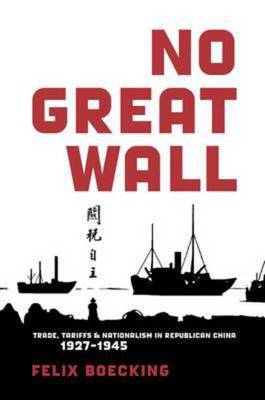
No Great Wall - Felix Boecking
Oops!
Unfortunately it looks like someone took the last one.
Unfortunately it looks like someone took the last one.
No worries, we have many more interesting finds for you.
Browse similar
Why choose musicMagpie?
Title
No Great Wall - trade, tariffs and nationalism in Republican China, 1927-1945
No Great Wall - trade, tariffs and nationalism in Republican China, 1927-1945
Author
Felix Boecking
Felix Boecking
format
Hardback
Hardback
Publisher
Harvard University Asia Center
Harvard University Asia Center
Language
English
English
UK Publication Date
20170728
20170728
Description
This book, an in-depth study of Nationalist tariff policy, fundamentally challenges the widely accepted idea that the key to the Communist seizure of power in China lay in the incompetence of Chiang Kai-shek's Nationalist government. It argues instead that during the second Sino-Japanese War, China's international trade, the Nationalist government's tariff revenues, and hence its fiscal policy and state-making project all collapsed.
Because tariffs on China's international trade produced the single greatest share of central government revenue during the Nanjing decade, the political existence of the Nationalist government depended on tariff revenue. Therefore, Chinese economic nationalism, both at the official and popular levels, had to be managed carefully so as not to jeopardize the Nationalist government's income. Until the outbreak of war in 1937, the Nationalists' management of international trade and China's government finances was largely successful in terms of producing increasing and sustainable revenues. Within the first year of war, however, the Nationalists lost territories producing 80 percent of tariff revenue. Hence, government revenue declined just as war-related expenditure increased, and the Nationalist government had to resort to more rapacious forms of revenue extraction-a decision that had disastrous consequences for both its finances and its political viability.
Why buy with musicMagpie?

FREE 12 Month Warranty on Tech

Magpie Certified Refurbished Tech

FREE Delivery on ALL Orders

14 Day Money Back Guarantee

90 Point Refurbished Quality Check
If you’re looking for something new to listen to, watch or play, look no further than the musicMagpie Store. We sell over half a million new and used CDs, DVDs, Blu-Rays, Games and Vinyl, spanning all kinds of genres and consoles, with prices starting from just £1.09! We also sell a wide range of refurbished Mobile Phones and Tech from major brands like Apple, Samsung, Sony, Microsoft and much more. With a 12 month quality warranty, you can save with total confidence.