










Item out of stock
Selling fast! Item low in stock
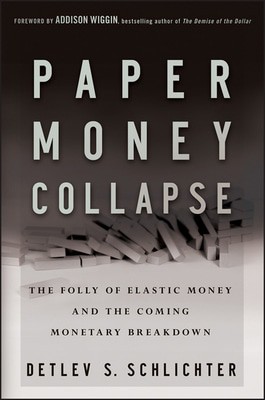
Paper money collapse - Detlev S. Schlichter
Oops!
Unfortunately it looks like someone took the last one.
Unfortunately it looks like someone took the last one.
No worries, we have many more interesting finds for you.
Browse similar
Oops!
Unfortunately it looks like someone took the last one.
Unfortunately it looks like someone took the last one.
No worries, we have many more interesting finds for you.
Browse similar
Why choose musicMagpie?
Title
Paper money collapse - the folly of elastic money and the coming monetary breakdown
Paper money collapse - the folly of elastic money and the coming monetary breakdown
Author
Detlev S. Schlichter
Detlev S. Schlichter
format
Hardback
Hardback
Publisher
Wiley
Wiley
Language
English
English
UK Publication Date
20110923
20110923
Description
"Detlev Schlichters new book is not an easy read.? Instead, it is an important read.? It explains why the worlds dollarbased, post1971 monetary system is not just inferior, it is unsustainable, unworkable, and unstable.? Its an elastic money system.? And before long, that elastic will snap, with very unhappy consequences for the many millions of people who depend on it." BILL BONNER, bestselling author, Financial Reckoning Day
"Detlev Schlichters book Paper Money Collapse develops a concise, clear, and at the same time deep economic analysis on the current elastic monetary system and why it is essentially incompatible with a free market economy. I strongly recommend this book to anyone interested in financial crises, economic recessions, and the future of capitalism."
JESS HUERTA DE SOTO, Professor of Political Enonomy, King Juan Carlos University (Madrid); author of Money, Bank Credit, and Economic Cycles
"Schlichters book is a terrifying window into our future. Every academic, politician, banker, and opinion former should read it now." STEVE BAKER, Member of Parliament for Wycombe
"Detlevs understanding and insight into central bank policy propelled him to being one of the worlds preeminent global bond managers. He cuts through the fog of central bank mystery by providing a clear description of their apparatus and methods. Going beyond the requisite professional skepticism, Detlev has trained his scholarly attention to highlighting the enormity of the potential further damage they may yet wreak on us."
KEN LEECH, former CIO, Western Asset Management Company
"Detlev Schlichter has written a lucid, hardhitting critique of what he identifies as the worlds twin financial scourges: central banks that produce an elastic supply of paper money and commercial banks that, through the alchemy of fractionalreserve banking, render central bank money many times more elastic.? Readers of Paper Money Collapse will, among other things, glean useful insights on how to protect themselves from paper moneys end game: an inflationary meltdown." STEVE H. HANKE, Professor of Applied Economics, Johns Hopkins University, Baltimore
Why buy with musicMagpie?

FREE 12 Month Warranty on Tech

Magpie Certified Refurbished Tech

FREE Delivery on ALL Orders

14 Day Money Back Guarantee

90 Point Refurbished Quality Check
If you’re looking for something new to listen to, watch or play, look no further than the musicMagpie Store. We sell over half a million new and used CDs, DVDs, Blu-Rays, Games and Vinyl, spanning all kinds of genres and consoles, with prices starting from just £1.09! We also sell a wide range of refurbished Mobile Phones and Tech from major brands like Apple, Samsung, Sony, Microsoft and much more. With a 12 month quality warranty, you can save with total confidence.