










Item out of stock
Selling fast! Item low in stock
Piety in Pieces - Kathryn M. Rudy
Oops!
Unfortunately it looks like someone took the last one.
Unfortunately it looks like someone took the last one.
No worries, we have many more interesting finds for you.
Browse similar
Why choose musicMagpie?
Title
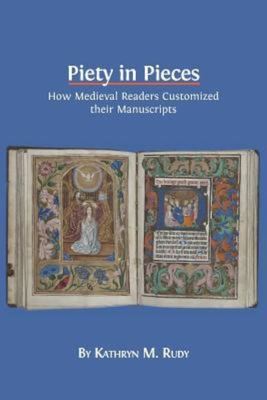
Piety in Pieces - How Medieval Readers Customized their Manuscripts
Piety in Pieces - How Medieval Readers Customized their Manuscripts
Author
Kathryn M. Rudy
Kathryn M. Rudy
format
Paperback / softback
Paperback / softback
Publisher
Lightning Source Uk Ltd
Lightning Source Uk Ltd
Language
English
English
UK Publication Date
20160926
20160926
Description
Medieval manuscripts resisted obsolescence. Made by highly specialised craftspeople (scribes, illuminators, book binders) with labour-intensive processes using exclusive and sometimes exotic materials (parchment made from dozens or hundreds of skins, inks and paints made from prized minerals, animals and plants), books were expensive and built to last. They usually outlived their owners. Rather than discard them when they were superseded, book owners found ways to update, amend and upcycle books or book parts.These activities accelerated in the fifteenth century. Most manuscripts made before 1390 were bespoke and made for a particular client, but those made after 1390 (especially books of hours) were increasingly made for an open market, in which the producer was not in direct contact with the buyer. Increased efficiency led to more generic products, which owners were motivated to personalise. It also led to more blank parchment in the book, for example, the backs of inserted miniatures and the blanks ends of textual components. Book buyers of the late fourteenth and throughout the fifteenth century still held onto the old connotations of manuscripts-that they were custom-made luxury items-even when the production had become impersonal.Owners consequently purchased books made for an open market and then personalised them, filling in the blank spaces, and even adding more components later. This would give them an affordable product, but one that still smacked of luxury and met their individual needs. They kept older books in circulation by amending them, attached items to generic books to make them more relevant and valuable, and added new prayers with escalating indulgences as the culture of salvation shifted.Rudy considers ways in which book owners adjusted the contents of their books from the simplest (add a marginal note, sew in a curtain) to the most complex (take the book apart, embellish the components with painted decoration, add more quires of parchment). By making sometimes extreme adjustments, book owners kept their books fashionable and emotionally relevant. This study explores the intersection of codicology and human desire.Rudy shows how increased modularisation of book making led to more standardisation but also to more opportunities for personalisation. She asks: What properties did parchment manuscripts have that printed books lacked? What are the interrelationships among technology, efficiency, skill loss and standardisation?
Why buy with musicMagpie?

FREE 12 Month Warranty on Tech

Magpie Certified Refurbished Tech

FREE Delivery on ALL Orders

14 Day Money Back Guarantee

90 Point Refurbished Quality Check
If you’re looking for something new to listen to, watch or play, look no further than the musicMagpie Store. We sell over half a million new and used CDs, DVDs, Blu-Rays, Games and Vinyl, spanning all kinds of genres and consoles, with prices starting from just £1.09! We also sell a wide range of refurbished Mobile Phones and Tech from major brands like Apple, Samsung, Sony, Microsoft and much more. With a 12 month quality warranty, you can save with total confidence.