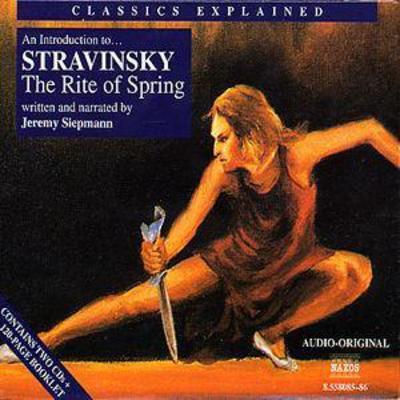
Disc 1:
1) Introduction, background and perspective (5.03)
2) A gentle, other-worldly start; no sign of the violence to come (1.33)
3) Music as mosaic; the composer as constructor (1.57)
4) Two functions of metrical change: going with the flow... (1.23)
5) ...or disrupting it: a sample of metrical violence (1.02)
6) A stealthy entry (clarinets) (0.34)
7) Detour: the destabilising properties of chromaticism (4.04)
8) On melodies, themes and motifs (1.03)
9) The new cor anglais motif dominates (0.27)
10) The oboe's rhythmic motif takes over (0.25)
11) A primeval awakening (0.37)
12) A panoply of Stravinskyan birdsong (0.58)
13) A matter of mode (1.15)
14) Cue to Introduction (0.08)
15) Introduction (complete) (3.38)
16) The 'Rite of Spring' chord (0.41)
17) The great arrival: bitonality (1.35)
18) Putting the boot in: a metrical mugging (1.45)
19) The prevalence of ostinatos, and a righting of wrongs (1.51)
20) Metre restored (briefly) but the 'savage motif' returns (0.50)
21) The musical savages routed (1.19)
22) An important new arrival (the 'horn motif') (1.04)
23) Another new theme from the horns (0.48)
24) A crowded conclusion (1.43)
25) A real study in contrasts (1.31)
26) Panic and pandemonium as timpani open fire (1.09)
27) Climactic melee haunted by 'fear motif' (1.34)
28) Suddenly another world, as flutes hover over harmonic vapour... (0.59)
29) ...but a transient one: new movement arises from the deep (0.50)
30) 'Dragging feet motif' over ostinato violins, twice interrupted (0.42)
31) 'Marching motif' developed further by flutes and horns (0.45)
32) A trilling commentary from piccolo and high clarinet (0.25)
33) 'Marching motif' theme goes polymetric in huge crescendo (1.16)
34) An unexpected change of pace as tempo doubles (0.53)
35) And an unexpected reversion, to a quiet close (0.41)
36) Violent onslaught from brass and timpani launches in 'Rival Tribes' (0.25)
37) Rival Tribes, rival motifs (0.22)
38) Sensational violence comes close to chaos (0.38)
39) Effects, impressions and alteration (1.39)
40) A surprise re-entry and a change of instrumental clothing (0.54)
41) A thinning of texture, a new idea, and a rude interruption (0.34)
42) The new idea developed: a minor earthquake (0.41)
43) The use of tone colour as an agent of rhythm (1.32)
44) An unusual climax... (1.30)
45) ... and a sinister transition (0.51)
46) Across the threshold into an instrumental population explosion (1.29)
47) A sudden silence and then another world (1.00)
48) Catapulted into the 'Dance of the Earth' (0.38)
49) Tiny changes, unyielding ostinatos, massive tension (3.19)
50) Cue to Part One complete (0.07)
51) Part One (complete) (16.08)
Disc 2:
1) Again a muted, subtly coloured start (1.09)
2) Tone colour as atmosphere - the strings' motif (1.07)
3) Four solo violas, above gently rocking strings (0.23)
4) A pregnant pause, and a new motif in muted trumpets (1.14)
5) Motif from the Introduction varied and extended (1.27)
6) New motif, heralded by clarinets and violins, is introduced by alto flute (0.34)
7) Variant of Motif No. 2 given out by two clarinets (0.44)
8) Continued by oboes and bassoons; new motif in violins, cellos and bass clarinet (0.33)
9) Main motifs yield to new idea from flutes (0.38)
10) All change - direction, tone colour, metre - and two new ostinatos (0.40)
11) Motif No. 1 returns in horn, then passed to flutes and strings (0.46)
12) Texture, balance and tone colour keep changing (0.26)
13) Instrumental enrichment, new counterpoint and a bleat of alarm (0.40)
14) New derivative of Motif No. 2, a host of new sounds - and again the bleat (0.48)
15) Into the finishing stretch, and we know we're in for something big (0.44)
16) Putting the movement back together again (0.07)
17) Mystic Circles of the Young Girls (complete) (8.16)
18) On into one of the most sensational movements ever written (1.36)
19) The violence is almost graphic. An example of musical terrorism (0.35)
20) Motif No. 2: a terrible, off-beat oom-pah from strings, horns and oboes (0.13)
21) The air is filled with the fearsome baying of wind and violins (0.20)
22) A variant of Motif No. 2, but now descending (0.14)
23) A study in the brutality of suspense - a musical mugging (4.12)
24) The middle section begins with a massive but unequal confrontation (0.27)
25) Against the odds, the 'descending motif' comes out on top (0.23)
26) In the midst of the fray, a new 'rising motif' emerges... (1.02)
27) ... and undergoes a typically Stravinskyan expansion and compression (1.03)
28) A much-needed breath before the movement entire (0.17)
29) Glorification of the Chosen One (complete) (1.45)
30) The next movement consists of a single, chordal motif, three times varied (0.58)
31) The second statement: breaking the metrical flow (2.13)
32) At last the establishment of a clear and steady beat, but will it last? (1.21)
33) A counterpoint of ostinatos lends continuity to changing time signatures (0.42)
34) Horns introduce the first real motif, destabilised by multiple metres (0.32)
35) The motif disappears, though the background ostinato continues (0.32)
36) A change of mood, then the whole orchestra crashes in (0.49)
37) The steady pulse gives way to a tossed salad of one-bar motifs (0.43)
38) Lately abandoned, the steady pulse returns, as does the 'trumpet motif' (1.06)
39) The movement ends with a varied reprise of the opening (0.15)
40) Evocation of the Ancestors (complete) and Ritual Action of the Ancestors (complete) (4.23)
41) The last movement is based on two motifs, the first most notable for its rhythm (0.20)
42) The second motif is likewise predominantly rhythmical in effect (0.16)
43) Two variants: one a rhythmic simplicfication, the other an expansion (0.20)
44) A new section, again with two main motifs, the first from wind and strings (0.27)
45) This is joined by another brief but very striking motif from muted brass (0.20)
46) Tension dramatically increased by a violent interruption from timpani and gong (0.35)
47) Motif No. 2 is passed from bassoons to high wind and trumpets... (0.34)
48) ... and is twice interrupted by horns (0.41)
49) Motif No. 1 erupts in full orchestra, then all hell breaks loose (0.48)
50) New ostinato, over implacable repetitions of Motif No. 1, offset by clarinets (0.26)
51) A new section, kick-started by percussion: timpani, bass drum and gong (1.11)
52) Horns, doubled by strings, introduce the main idea of this new section (0.18)
53) The return of the movement's opening section - or so we may think (0.54)
54) Dramatic compression of now-familiar material (0.40)
55) A terrifying cocktail of motifs old and new confounds expectations... (1.00)
56) ... and leads to the coda, the final flourish of the whole work (1.45)
57) Cue to all of Part Two and end of CD (0.10)
58) Part Two (complete) (18.58)