










Item out of stock
Selling fast! Item low in stock
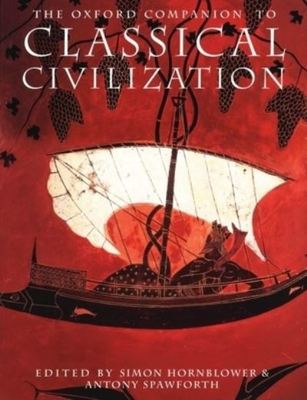
The Oxford companion to classical civilization - Simon Hornblower
Oops!
Unfortunately it looks like someone took the last one.
Unfortunately it looks like someone took the last one.
No worries, we have many more interesting finds for you.
Browse similar
Oops!
Unfortunately it looks like someone took the last one.
Unfortunately it looks like someone took the last one.
No worries, we have many more interesting finds for you.
Browse similar
Why choose musicMagpie?
Title
The Oxford companion to classical civilization
The Oxford companion to classical civilization
Author
Simon Hornblower
Simon Hornblower
format
Paperback / softback
Paperback / softback
Publisher
OUP Oxford
OUP Oxford
Language
English
English
UK Publication Date
20040923
20040923
Description
How did the ancient Greeks and Romans differ in their attitude towards alcoholism? What role did dance play in religious rituals? What did the ancient Greeks eat? Why was emperor Nero popular with the ordinary people but less so with the upper classes? How did ancient authors reason why Oedipus ('with swollen foot') was so called?For over 2,000 years the civilizations of ancient Greece and Rome have captivated our collective imagination and provided inspiration for so many aspects of our lives, from culture, literature, drama, cinema, and television to society, education, and politics. Many of the roots to the way life is lived in the West today can be traced to the ancient civilizations, not only in politics, law, technology, philosophy, and science, but also in social and family life, language, and art.Beautiful illustrations, easy-to-use jargon free entries, and a useful chronology and bibliography make this Companion the perfect guide for readers interested in learning more about the Graeco-Roman world. As well as providing sound information on all aspects of classical civilization such as history, politics, ethics, morals, law, society, religion, mythology, science and technology, language, literature, art, and scholarship, the entries in the Companion reflect thechanging interdisciplinary aspects of classical studies, covering broad thematic subjects, such as race, nationalism, and ecology, confirming the impact classical civilizations have had on the modern world.HISTORY AND POLITICS the events, achievements, and personalities of 2,000 years of history in Greece and Rome and their immediate neighbours and the underlying issuesthemes: armies, banks, bribery, class struggle, democracy, economy, oligarchy, tyrannyindividuals: Agrippa, Mark Antony, Augustus, Cleopatra VII, Domitian, Livia, Nero, Quintus, Pyrrhus, TrajanETHICS AND MORALS, LAW AND PUNISHMENT, ECONOMICSindividual philosophers and their schools, and ethical issues, attitudes to animals, to wealth, or to warfare, and intellectual or religious intolerance themes: abortion, adoption, adultery, alcoholism, barbarian, capitalism, debt, imperialism, industry, marriage law, prison, slavery, tortureInstitutions: banks, police, senateSOCIAL AND FAMILY LIFEthe everyday lives of the ancients and broader social topics covering status, kinship and the familythemes: age, chastity, childbirth, class-struggle, cookery, dancing, dress, food and drink, games, heterosexuality, homosexuality, houses, incest, kinship, meals, suicide, tourism, womenLANGUAGE, LITERATURE, ART, AND SCHOLARSHIP writers and poets, orators and playwrights, literacy and books, archives and education, literary genres, painting and sculpture, and the writing of historythemes: art, bilingualism, books, comedy, epic, fantastic literature, gardens, genre, maps, narrative, novel, orality, pottery, reception, satire, tragedyindividuals: Achilles, Alcaeus, Aristophanes, Cicero, Euripides, Horace, Isocrates, Odysseus, Seneca, Sophocles, Virgil, XenophonRELIGION AND MYTHOLOGYGreek, Roman, and Egyptian beliefs, cults, and rituals, together with their attendant deities and mythological creatures, mingle with Judaism and early Christianitythemes: cakes, dancing, games, initiation, intolerance, magic, mythology, oracles, prayer, ruler-cult, sacrifice, sin, templeindividuals: Achilles, Aphrodite, Apollo, Hector, Heracles, Oedipus, ZeusTECHNOLOGY, SCIENCE, AND MEDICINEthe birth of the scientific method in experiment, and all manner of discovery, exploration, treatment, and theorizing on disease, geography, climate, astronomy, mineralogy, navigation, sanitation, vivisection themes: agriculture, anatomy and physiology, anthropology, artillery, astronomy, botany, disease, ecology, famine, geography, mathematics, medicine, navigation, physics, sanitation
Why buy with musicMagpie?

FREE 12 Month Warranty on Tech

Magpie Certified Refurbished Tech

FREE Delivery on ALL Orders

14 Day Money Back Guarantee

90 Point Refurbished Quality Check
If you’re looking for something new to listen to, watch or play, look no further than the musicMagpie Store. We sell over half a million new and used CDs, DVDs, Blu-Rays, Games and Vinyl, spanning all kinds of genres and consoles, with prices starting from just £1.09! We also sell a wide range of refurbished Mobile Phones and Tech from major brands like Apple, Samsung, Sony, Microsoft and much more. With a 12 month quality warranty, you can save with total confidence.