










Item out of stock
Selling fast! Item low in stock
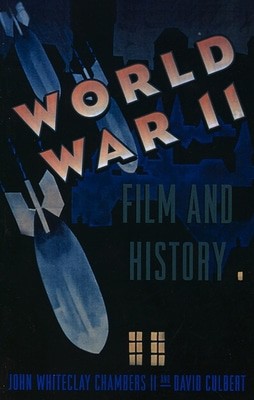
World War II, film, and history - John Whiteclay Chambers
Oops!
Unfortunately it looks like someone took the last one.
Unfortunately it looks like someone took the last one.
No worries, we have many more interesting finds for you.
Browse similar
Why choose musicMagpie?
Title
World War II, film, and history
World War II, film, and history
Author
John Whiteclay Chambers
John Whiteclay Chambers
format
Paperback / softback
Paperback / softback
Publisher
Oxford University Press
Oxford University Press
Language
English
English
UK Publication Date
19961001
19961001
Description
The immediacy and perceived truth of the visual image, as well as film and television's ability to propel viewers back into the past, place the genre of the historical film in a special category. War films-including antiwar films-have established the prevailing public image of war in the twentieth century. For American audiences, the dominant image of trench warfare in World War I has been provided by feature films such as All Quiet on the Western Frontand Paths of Glory. The image of combat in the Second World War has been shaped by films like Sands of Iwo Jima and The Longest Day. And despite claims for the alleged impact of widespread television coverage of the Vietnam War, it is actually films such as Apocalypse Now and Platoon which have provided themost powerful images of what is seen as the "reality" of that much disputed conflict. But to what degree does history written "with lightning," as Woodrow Wilson allegedly said, represent the reality of the past? To what extent is visual history an oversimplification, or even a distortion of the past?
Exploring the relationship between moving images and the society and culture in which they were produced and received, World War II, Film, and History addresses the power these images have had in determining our perception and memories of war. Examining how the public memory of war in the twentieth century has often been created more by a manufactured past than a remembered one, a leading group of historians discusses films dating from the early 1930s through the early 1990s,created by filmmakers the world over, from the United States and Germany to Japan and the former Soviet Union. For example, Freda Freiberg explains how the inter-racial melodramatic Japanese feature film China Nights, in which a manly and protective Japanese naval officer falls in love with a beautiful youngChinese street waif and molds her into a cultured, submissive wife, proved enormously popular with wartime Japanese and helped justify the invasion of China in the minds of many Japanese viewers. Peter Paret assesses the historical accuracy of Kolberg as a depiction of an unsuccessful siege of that German city by a French Army in 1807, and explores how the film, released by Hitler's regime in January 1945, explicitly called for civilian sacrifice and last-ditch resistance. StephenAmbrose contrasts what we know about the historical reality of the Allied D-Day landings in Normandy on June 6, 1944, with the 1962 release of The Longest Day, in which the major climactic moment in the film never happened at Normandy. Alice Kessler-Harris examines The Life and Times of Rosie the Riveter, a 1982film documentary about women defense workers on the American home front in World War II, emphasizing the degree to which the documentary's engaging main characters and its message of the need for fair and equal treatment for women resonates with many contemporary viewers. And Clement Alexander Price contrasts Men of Bronze, William Miles's fine documentary about black American soldiers who fought in France in World War I, with Liberators, the controversial documentary by Milesand Nina Rosenblum which incorrectly claimed that African-American troops liberated Holocaust survivors at Dachau in World War II.
In today's visually-oriented world, powerful images, even images of images, are circulated in an eternal cycle, gaining increased acceptance through repetition. History becomes an endless loop, in which repeated images validate and reconfirm each other. Based on archival materials, many of which have become only recently available, World War II, Film, and History offers an informative and a disturbing look at the complex relationship between national myths and filmic memory, aswell as the dangers of visual images being transformed into "reality."
Exploring the relationship between moving images and the society and culture in which they were produced and received, World War II, Film, and History addresses the power these images have had in determining our perception and memories of war. Examining how the public memory of war in the twentieth century has often been created more by a manufactured past than a remembered one, a leading group of historians discusses films dating from the early 1930s through the early 1990s,created by filmmakers the world over, from the United States and Germany to Japan and the former Soviet Union. For example, Freda Freiberg explains how the inter-racial melodramatic Japanese feature film China Nights, in which a manly and protective Japanese naval officer falls in love with a beautiful youngChinese street waif and molds her into a cultured, submissive wife, proved enormously popular with wartime Japanese and helped justify the invasion of China in the minds of many Japanese viewers. Peter Paret assesses the historical accuracy of Kolberg as a depiction of an unsuccessful siege of that German city by a French Army in 1807, and explores how the film, released by Hitler's regime in January 1945, explicitly called for civilian sacrifice and last-ditch resistance. StephenAmbrose contrasts what we know about the historical reality of the Allied D-Day landings in Normandy on June 6, 1944, with the 1962 release of The Longest Day, in which the major climactic moment in the film never happened at Normandy. Alice Kessler-Harris examines The Life and Times of Rosie the Riveter, a 1982film documentary about women defense workers on the American home front in World War II, emphasizing the degree to which the documentary's engaging main characters and its message of the need for fair and equal treatment for women resonates with many contemporary viewers. And Clement Alexander Price contrasts Men of Bronze, William Miles's fine documentary about black American soldiers who fought in France in World War I, with Liberators, the controversial documentary by Milesand Nina Rosenblum which incorrectly claimed that African-American troops liberated Holocaust survivors at Dachau in World War II.
In today's visually-oriented world, powerful images, even images of images, are circulated in an eternal cycle, gaining increased acceptance through repetition. History becomes an endless loop, in which repeated images validate and reconfirm each other. Based on archival materials, many of which have become only recently available, World War II, Film, and History offers an informative and a disturbing look at the complex relationship between national myths and filmic memory, aswell as the dangers of visual images being transformed into "reality."
Why buy with musicMagpie?

FREE 12 Month Warranty on Tech

Magpie Certified Refurbished Tech

FREE Delivery on ALL Orders

14 Day Money Back Guarantee

90 Point Refurbished Quality Check
If you’re looking for something new to listen to, watch or play, look no further than the musicMagpie Store. We sell over half a million new and used CDs, DVDs, Blu-Rays, Games and Vinyl, spanning all kinds of genres and consoles, with prices starting from just £1.09! We also sell a wide range of refurbished Mobile Phones and Tech from major brands like Apple, Samsung, Sony, Microsoft and much more. With a 12 month quality warranty, you can save with total confidence.